
If you have just been in a car accident in Denver, the most useful thing you can do is slow down. Most of what later helps or hurts a claim happens in the next few hours, and almost none of it requires a lawyer to be on the phone.
This page lays out what to do after a car accident in Denver in the order it usually comes up. It explains the general Colorado rules in plain terms and points to the deeper guides when a step gets complicated. It is general information, not legal advice. If anyone was hurt, a government vehicle was involved, or the other driver's insurer is pushing you to sign something, talk to a licensed Colorado attorney.
At the Scene: Safety, Then Information
Start with people. Check yourself, your passengers and the other car. If anyone is hurt, or if a car is blocking traffic in a dangerous spot, call 911. On a busy stretch like I-25, Colfax or Federal, getting everyone out of the travel lanes matters more than preserving the exact resting position of the cars, as long as moving them is safe.
Colorado's traffic code puts a few duties on every driver involved in a crash. You must stop. If someone is injured you must give reasonable help, which can be as simple as calling for an ambulance. You must give your name, address and vehicle registration, and show your license if asked. And the crash has to be reported to police. Those duties come from C.R.S. 42-4-1602 through 42-4-1606. Leaving the scene of a crash with injuries is a crime in Colorado, so even a scary, chaotic scene is a reason to stay.
What to collect before anyone leaves
- The other driver's name, phone number, license number and insurance company with policy number. A photo of their insurance card and license is faster and more accurate than writing.
- The license plate, make, model and color of every vehicle involved.
- Names and phone numbers of witnesses. Independent witnesses are hard to find later.
- The responding officer's name and the case or report number.
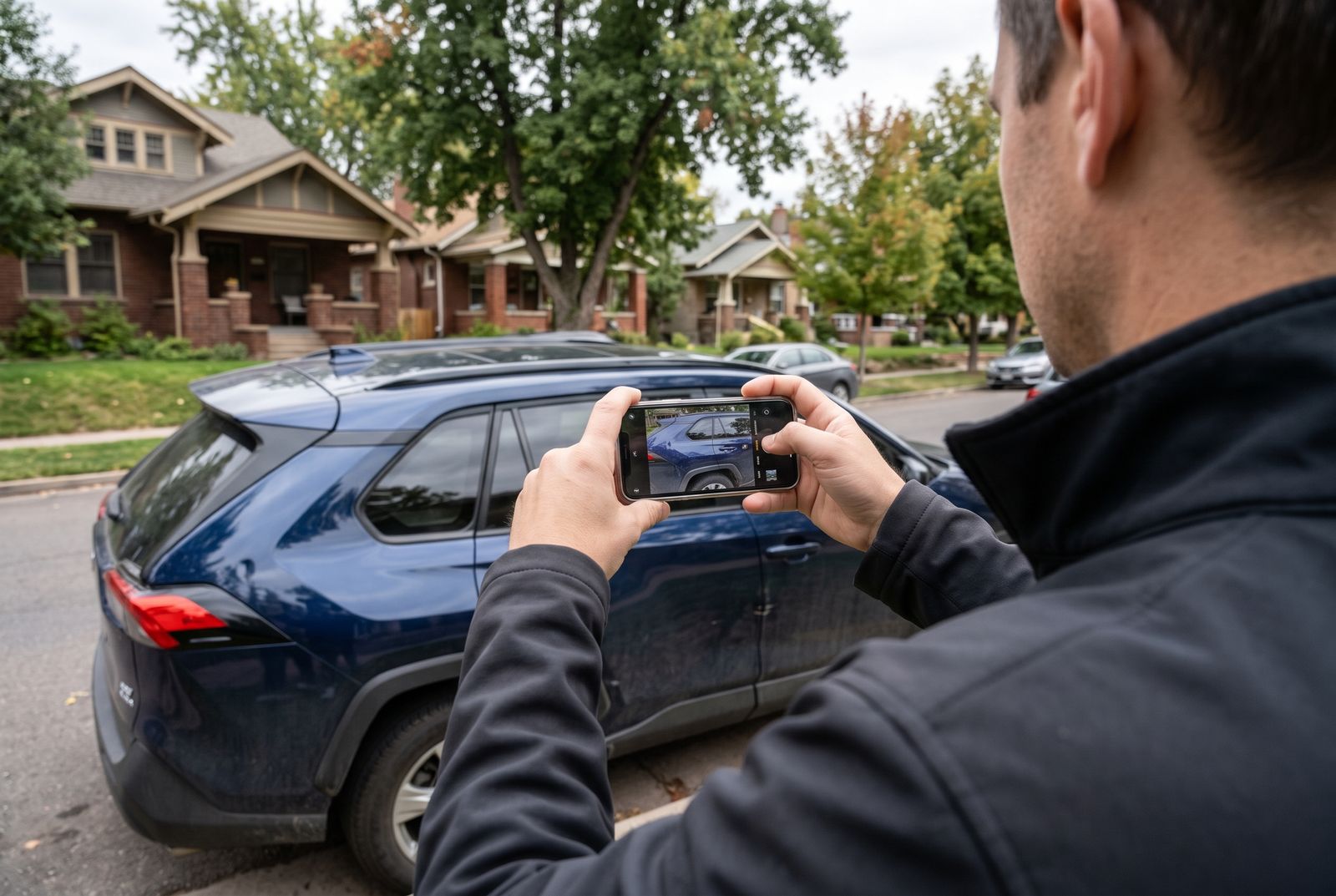
- Photos: wide shots that show the intersection or lane layout, mid shots of each car, close shots of damage, traffic signals, signs, skid marks, debris, weather and lighting.
Turn on your phone's location stamp before you take photos, and take a short video walking around both cars. Video captures the order of things in a way stills do not, and the timestamp quietly answers questions about when and where.
The Denver Crash Checklist
Tick items as you go. Your progress is saved only in this browser on this device; nothing is sent anywhere.
Crash checklist
0 doneAt the scene
First day
First week
Police Reports in Denver
The police report is usually the first document an adjuster asks for. It lists the drivers, vehicles, insurers and witnesses, and it often includes a diagram, the officer's observations and any citations issued. It does not decide fault for an insurance claim or a lawsuit, but it carries real weight, which is why it is worth reading carefully once you get a copy.
Which agency responds depends on where the crash happened. Inside Denver city limits that is usually the Denver Police Department; on some highways it may be the Colorado State Patrol; in neighboring suburbs it is the local police or sheriff. For minor, injury-free collisions, an agency may ask drivers to file a counter or online report themselves instead of sending an officer. Ask the dispatcher, and follow the instructions you are given. Reporting procedures change, so check the agency's own website for the current process and fees.
Factual errors such as a wrong plate or insurer can often be corrected by contacting the agency. Disagreements about how the crash happened are different: the officer's opinion usually stays, but you can typically submit your own written statement. Keep it short and factual.
The First Day: Medical Care and Your Own Insurer
Adrenaline hides pain. Soft-tissue injuries, concussions and back injuries often show up the next morning. Getting checked the same day or the next is first about your health. It also creates a dated record that links your symptoms to the crash, which matters because insurers look closely at gaps between the crash and the first visit.
Next, notify your own insurer. Most policies require prompt notice, and your policy may hold coverage you have forgotten about: Medical Payments coverage, uninsured and underinsured motorist coverage, rental reimbursement or collision. Give the basic facts: date, time, place, vehicles and report number. Do not guess at speeds or distances. "I'm not sure" is a complete answer.
- Ifno one was hurt and damage is minor, a property damage claim with the at-fault driver's insurer, or your own collision coverage, is often enough.
- Ifsomeone was hurt, start medical care, keep every record, and read the guide to car accident medical bills in Colorado.
- Ifthe other driver fled or had no insurance, report it to police right away and ask your insurer about uninsured motorist coverage.
- Ifa city bus, police car, snowplow or road condition was involved, read about the 182-day notice in the Colorado car accident deadline guide today.
The First Week: Adjusters, Paperwork and Deadlines
Within a few days you will probably hear from the other driver's insurance adjuster. Adjusters are often friendly and quick. They also work for their policyholder and their company. You can ask them to communicate in writing. In general you are not required to give the other driver's insurer a recorded statement, and you should read any release or medical authorization form slowly before signing it, because some are much broader than they need to be. The Colorado car accident insurance claims guide goes deeper on recorded statements and early offers.
Start a single folder, paper or digital. Put everything in it: the police report, photos, repair estimates, rental receipts, medical bills, explanation-of-benefits letters, and a simple log of missed work and calls with insurers (date, person, what was said). A claim that is organized is easier to evaluate, for you and for any attorney you consult.
Finally, write the crash date somewhere you will see it. Colorado's general deadline for car accident lawsuits is three years, but some claims have much shorter windows. Knowing the date is how you avoid being surprised by one.
Common Mistakes That Cost People Later
| What people do | Why it causes trouble | What to do instead |
|---|---|---|
| Say "I'm fine" at the scene | The statement ends up in notes and contradicts a later diagnosis. | Say you will get checked, then do it. |
| Post about the crash online | Photos and comments are easy for insurers to find and quote out of context. | Stay off social media about the crash and your recovery. |
| Accept the first offer quickly | Early offers often come before the full medical picture is known. | Wait until you understand your injuries and costs. |
| Skip follow-up appointments | Gaps in care are read as a sign the injury was minor. | Follow your provider's plan or document why you could not. |
| Lose track of the date | Missing a deadline can end a claim no matter how strong it was. | Mark the crash date and read the deadline guide. |
None of these mistakes is fatal on its own. Together they make a claim harder to prove. If you are past the first week and wondering whether you need help, the guide to choosing a Denver car accident lawyer covers when people usually call one and what to ask.
Questions About the First Days After a Crash
Do I have to call the police after a minor crash in Denver?
Colorado law requires the drivers involved in a crash to report it to police by the quickest available means (C.R.S. 42-4-1606). For a small, injury-free collision the responding agency may direct you to file a report yourself instead of sending an officer. Ask the dispatcher what they want you to do, and write down the case or report number either way.
Should I say sorry to the other driver?
Being polite is fine. Saying "this was my fault" is different, because statements at the scene can be repeated later by the other driver, a witness or an insurer. Stick to checking on people and exchanging information. Fault is decided later, with evidence.
What if the other driver has no insurance or drives away?
Call police right away and give them every detail you have, including a partial plate. Then tell your own insurer. Uninsured motorist coverage, if you have it, is designed for this situation. The Colorado insurance claims guide explains how UM coverage works.
How soon should I see a doctor after a car accident?
As soon as you reasonably can, ideally the same day or the next. Some injuries take a day or two to show symptoms. A prompt visit is first about your health, and it also creates a dated record that connects your symptoms to the crash.
Still unsure about a step?Send a short, general question. No confidential details, please.
Ask a question